Essay 1
From the Mouths of Monsters: Story Breakdown
From the Mouths of Monsters is an existential play that combines elements of a coming-of-age story with a wise meditation of artistic identity, along with some horror elements to produce a striking and unique piece. The play is divided into lightning-bolt-punctuated vignettes (taking a page from its inspirational source material: Mary Shelley’s Frankenstein), which may make the story feel fragmented or disparate. The purpose of this essay is to dig into illuminative questions on structure and character, and concludes with an open discussion on mental health in the play: an area that the playwright, Idris Goodwin, has made both vague and critical to the story.
First of all: who is the main character and what does she want? From the opening scene between Michelle and Dr. Franklin, we see Michelle as a character in search of a way to reach people. As a self-perceived “quiet girl,” Michelle desperately wants a voice that is her own, and she mocks the ‘inauthenticity’ of others.
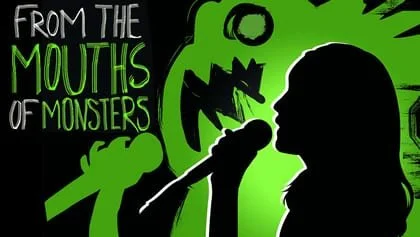
Original graphic design for the Kennedy Center’s 2017 production.
How does she begin her journey? When Penelope introduces Michelle to spoken word poetry, Michelle finally sees a place where she can become someone else, someone who is listened to. From that moment on, she begins to cultivate her ‘other’ persona. The culmination of this and the ‘point of no return’ is when she accepts the mask from Dr. Franklin.
What is at stake if she does not succeed? While the story might point to Michelle’s relationships being most at stake, we also know the stakes go deeper than that. In addition to losing connections with her family and friends, Michelle is in danger of MonsterShelley taking over completely, thus losing herself (see mental health discussion notes, below).
What/Who stands in her way? Several literal forces work against Michelle: her brother, her father, Prometheus, the judges who dislike her going after other poets. Instead of receiving feedback and criticism from them, though, that her persona is becoming toxic, Michelle doubles down. The theme of ‘community over self,’ which runs through the play, begins to tilt strongly toward ‘self over all,’ which is a direct rebuttal to the precepts and foundations of spoken word poetry.
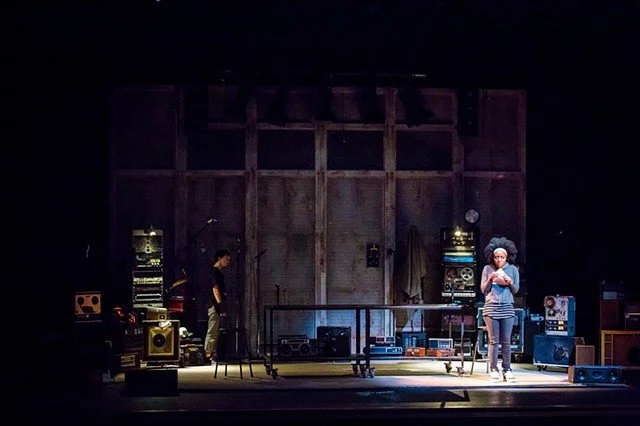
(L-R) Tia Shearer and Shannon Dorsey in the Kennedy Center Production
When do we pass the ‘point of no return?’ I would posit that Michelle’s rudeness to Penelope represents a point of no return. Penelope is not an active agent standing in Michelle’s way: in fact, she was the one who introduced her to spoken word poetry. Michelle rejecting her friend is the ultimate severing of community as she chooses to listen only to what her self-centered emotions are telling her.
When is the climax and why does she change? I do a deep dive on the climax of this play - particularly the role of The Dead the appearance of Michelle’s mother - in Essay #2. I do think Michelle’s ‘protest of The Dead’ serves as the climax, as Michelle turns on almost everyone. Her mother’s influence in changing her mind is powerful as it is based on the reason for her quietness at the top of the play: lingering trauma over her mother’s death and Penelope’s sudden move, which might be the underlying reason for her withdrawal from community at the top of the play.
For more dramaturgical questions that might help you understand the play:
https://theatrenerds.com/everyday-dramaturgy-crafting-character-3-critical-questions/
https://www.theatrefolk.com/blog/uta-hagens-nine-questions/
Questions for Discussion on Mental Health
How does Michelle’s mental health - and that topic in general - operate in the story structure I’ve laid out, above? Is it an instigator of Michelle’s journey? Does knowing about it raise the stakes? Contribute to the conflict? Goodwin does not give us easy answers, which is a good thing: it opens up the idea that this very difficult and challenging topic should be at the discretion of the company. To that end, I am including a suggested discussion.
Before discussion, leader must set discussion guidelines with the group. These might include: 1) being respectful of what someone shares and if they decide not to share; 2) words to avoid; 3) forecasting the conversation structure. Group members should be given time to share any guidelines that might benefit the group that the leader has not thought of. This can be done through open discussion, or anonymously, through slips of paper given to the leader or another method.
On a sheet of paper, write an answer to: what does mental health mean to you?
Then, in small groups of 3-4 (with a leader present, either the director, stage manager, etc.): can discuss answers to first question and answer: what does mental health mean to us as a group?
Still in small groups: What role does mental health have in this play? (and/or: What role do you want it to have?)
Return to the large group. Groups can share what they learned. This should be an unstructured time, with the director using what they hear to help shape how mental health is presented in the play.
Finish the exercise with the director saying: ‘I’m hearing…’ and ensuring that what the actors are meaning is coming across.
Conclude by checking in, if desired.
For more resources on mental health discussions: https://store.samhsa.gov/sites/default/files/d7/priv/sma13-4764.pdf
Essay 2
The Modern-Modern Prometheus: An Overview of Frankenstein References in From the Mouths of Monsters
Upon first read or viewing, someone experiencing Idris Goodwin’s From the Mouths of Monsters may draw precious few connections to Mary Shelley’s 19th century classic, Frankenstein. This person would not be alone in their befuddlement: in a 2017 review of the world premiere, DC Metro Arts critic Andra Abramson, admitted that “if I hadn’t been told [that the story is loosely based on Frankenstein], I wouldn’t have made the connection myself.” Any confusion seems to belie Goodwin’s use of the source material as a celebration of the one hundredth anniversary of the 1818 Frankenstein coming into print; however, it also encourages us strongly to use the classic novel to unlock Goodwin’s ideas, goals, and themes for the play.
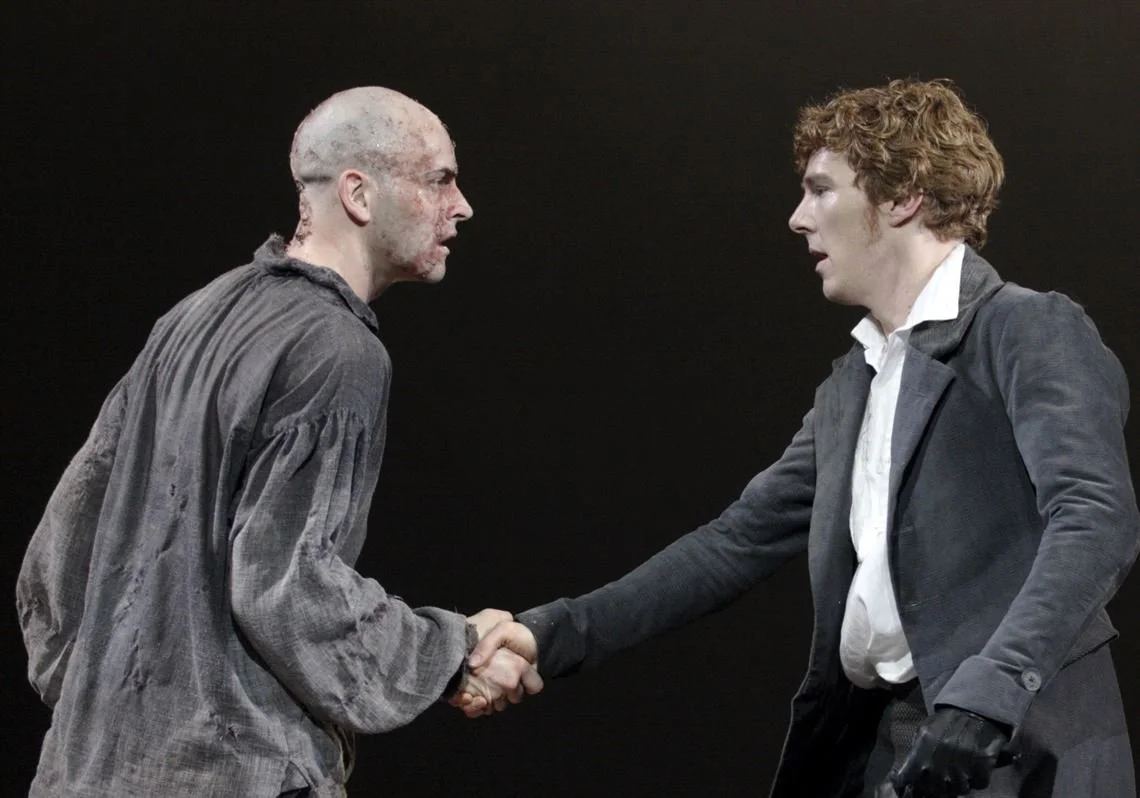
The Creature shaking hands with his Maker (or as I like to call it: Sherlock, meet Sherlock): Johnny Lee Miller and Benedict Cumberbatch at the National Theatre
While some of the play’s references to Frankenstein are ‘surface-y,’ with an almost Easter-Egg-like quality (‘Michelle’ -> ‘Shelley’ -> ‘Mary Shelley’ - GET IT?), there are deeper meanings and inferences even in association with these clear signals that might not be immediately obvious, but enrich the work. The purpose of this essay is to identify and explore those connections for the actors in Central Florida Community Arts’ production. I posit that this analysis tells us a great deal about how trauma and identity operate both in Frankenstein and in the play, and that these are central to Goodwin’s vision.
First, to trauma and Michelle’s loss of her mother. This may feel like an odd place to begin, given that Michelle’s mother is a vague figure until almost the end of the play; however, her placement in the structure of the story (guiding Michelle’s turning point!) signals her importance. Her name is also meaningful: Mary Shelley’s own mother’s name was Mary (the writer & feminist Mary Wollstonecraft).
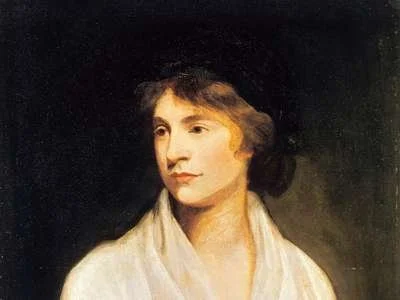
Mary Wollstonecraft
To bring in the novel: most scholars agree strongly that Frankenstein was an attempt by Shelley to process the death of her mother. In the novel, Frankenstein’s own mother is dead; in fact, according to scholar Richard Gunderman, “mothers in Frankenstein are conspicuous by their absence - with disastrous consequences.” Is Frankenstein’s creation of the monster an attempt to take control over death? It appears so: in fact, many scholars see Frankenstein as less of a ‘father’ figure and more of a mother: creating life (and then, unfortunately, abandoning it).
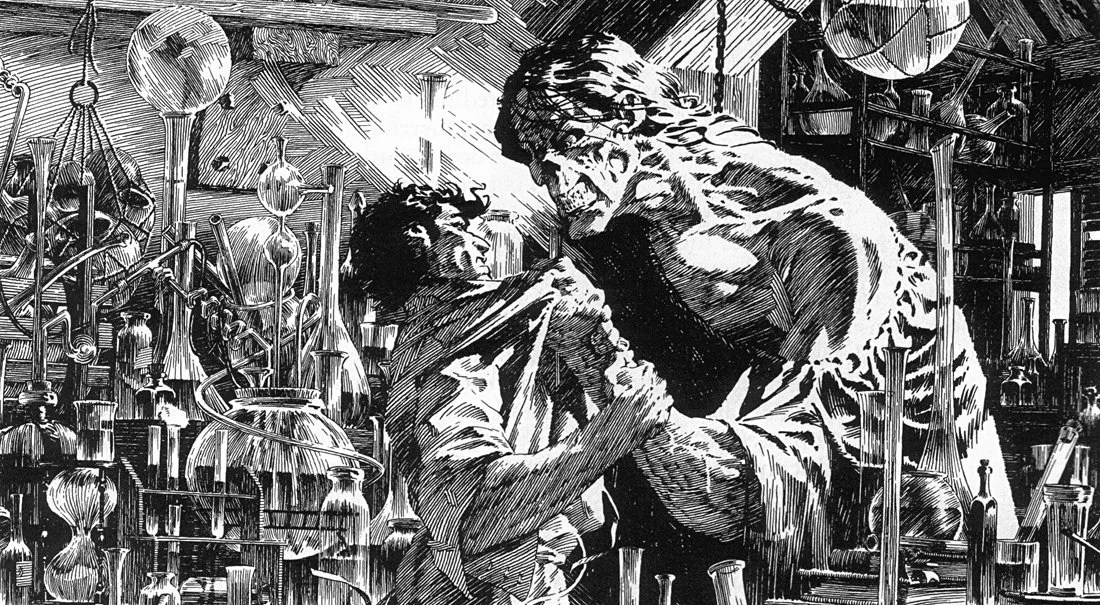
So how do we connect this to From the Mouths of Monsters? Put quite simply: we need to take seriously Michelle’s trauma on page one, when she freaks out over someone asking about her mother. Her growing silence about her mother speaks volumes: there’s a tension in the moment when Penelope mentions her own mother, or when others bring up happy families, or the ‘-’ lines when Will makes reference to Mary, it’s simply in the subtext, waiting to burst forth. I would go so far as to claim that Mary’s death is the motivation for Michelle’s decisions throughout the play, as she tries to create life out of death, saying on page 54: “I brought you back. I DID” - only to discover, as Frankenstein does, the terrible cost of playing God.
Which brings us to identity and how Michelle creates life. The screenname MonsterShelley actually tells us a great deal: in assuming her abrasive, self-indulgent identity, she is both creator and monster. Dr. Franklin is also a tendril of this imagined self: the one giving permission (and the speculative sci-fi-esque know-how) to bring MonsterShelley to life. ‘Prometheus’ not only references the hubris of that specific character, but also connects to Frankenstein’s original title (‘The Modern Prometheus’) and connects the poet’s toxic individualism to the makeup of the monster.
The character(s) of The Dead provide a fascinating layer to this idea of identity: we might infer that they are meant to infer the bodies stolen and used by Frankenstein to create the monster. In Michelle’s case, she is mining the tragedies and histories of those who came before to create her new self. On page 37, The Dead speak to her: “We been buried, yes - we do not rest - we have much still on your chest.” The Dead represent many things, but grave-robbing is almost certainly one of them - there is a (potentially, apocryphal) story that Mary Shelley was afraid grave-robbers would steal her mother’s body. This begs the question: as creatives, are we free to ‘borrow’ the voices, concerns, and traumas (‘body parts’) of those who came before us?
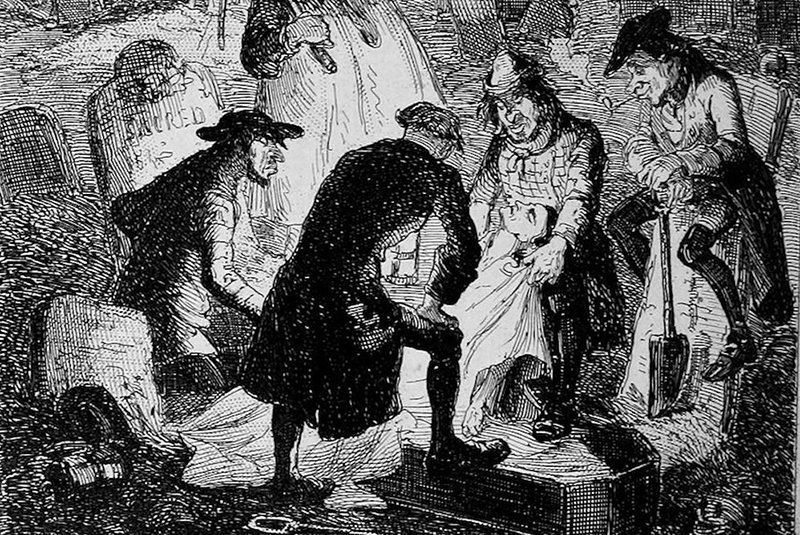
A 19th-century illustration of grave-robbing. Cadavers were in high demand for use in medical sciences, making grave-robbing quite profitable.
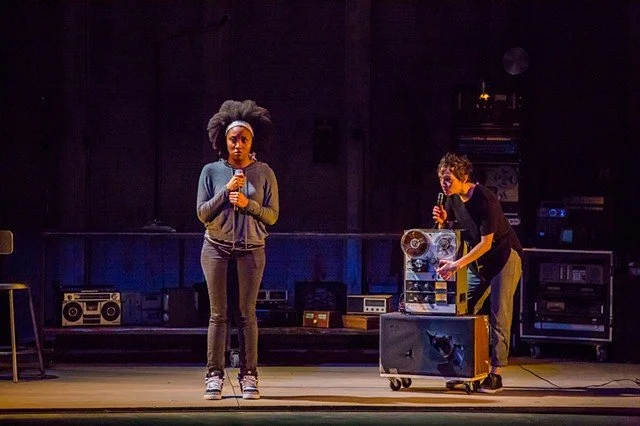
Instead of creating a literal monster, Michelle (played in the 2017 world premiere by Shannon Dorsey, left) creates her spoken word poetry persona, with Tia Shearer providing the beat.
Whatever our conclusions about Michelle’s new identity being connected to the monster, we must remember that Goodwin here is not insisting that MonsterShelley is truly, irredeemably ‘monstrous.’ Like the character in the novel, MonsterShelley is new at this ‘life’ thing: terrified and terribly alone. Still, the monster does have the capacity to - and does - murder people in his attempts to find answers, closure, and acceptance. In referencing Shelley’s novel, Goodwin creates a character that almost feels at odds with modern culture’s ‘embrace your unique voice’ culture and feels more at home in the 19th century - except in his story, trauma is addressed, leading to what is certainly the biggest change from the book - a happy ending. :)
References for further reading and where I got my info:
https://dcmetrotheaterarts.com/2017/03/11/review-mouths-monsters-kennedy-center/
https://www.frankenbook.org/pub/frankenstein-gender-mother-nature/release/3
https://spillwords.com/frankenstein-his-monster-grave-robbers-and-anatomists/
Discussion Questions:
In modern society, we encourage people to share their truths and their voices. One critic of From the Mouths of Monsters mentions that the climax of the play is disappointing because Michelle’s ‘lesson’ is to ‘self-censor.’ Do you think Michelle is ‘self-censoring’ at the end by walking away from MonsterShelley? Why did she create that specific voice?
‘Clarence’ is almost certainly a reference to Henry Clerval, Frankenstein’s friend in the book. Look up Clerval (online or in the glossary I’ve provided! It’s in there, somewhere…) and read about his part in the story. What are the parallels you see to the little brother in From the Mouths of Monsters?
Read the scene between Mary, MonsterShelly, and Michelle (pages 53-57). Underline the line that you feel most explains why Michelle decides to change. What convinces her? Discuss.
Essay 3
Breaking It Down: The Poetics of From the Mouths of Monsters
Spoken word poetry is distinct from poetry in general because it is meant to be performed and heard onstage. Audience reaction and rhythm are both central to spoken word as a form; more central, perhaps, then other types of poetry.
At the end of the day, however, spoken word embraces an understanding and language of poetics that is universal to the form. The purpose of my essay here is to introduce you to terms within rhyming and wordplay that will enrich your understanding of the poetry in From the Mouths of Monsters. For Michelle, MonsterShelley, and Prometheus, in particular, the skillset of poetics is absolutely essential to establishing these characters’ ‘flow,’ or presentation style, which in turn informs character and identity. For other actors in the show, this is still a relevant topic: the general musicality of Goodwin’s writing demands an introduction to these terms.
My conceptual structure for this essay is based on the book, Book of Rhymes, by Adam Bradley - a book I highly recommend for this play, though it does center on MC-ing instead of spoken word, a lot of the knowledge is transferable. When you see anything in quotes, it is from that book.
RHYME
Perfect rhyme: “a rhyme where words contain the same vowel sounds (usually accented) followed by identical consonant sounds.”
“I have every intent / to spark revolution / like steel to the flint” (page 10)
“Brash bold / Sassy, cold” (page 20)
Rolling around in purple shades / From your feet to your braids (page 9)
Slant Rhyme: rhymes the same consonant sounds with different vowels
“And the scores / and my own words” (page 17)
Apocopated Rhyme: “where a one-syllable word rhymes with the stressed portion of a multi-syllabic word”
But I barely broke sweat / They called me harlot and harpy / Rule bending suffragette (pages 9-10)
Mosaic Rhyme: “involves rhyming a single multisyllabic word with several monosyllabic words”
“(And yes that was a diss!) / “You sound bitter Michelle” Is it obvious?” (page 42)
Alliteration: “The repetition of initial consonant sound.”
“She said it is made by the ones who step on the heads of their sisters / Shove aside and talk over their sisters” (page 21)
Consonance: Alliteration but the consonant sound can come from anywhere, not necessary at the top of the line.
Build bricks round me / They push my face in the water / Try and drown me / With weapons drawn round me / But I barely broke sweat (page 9)
Assonance: the repeating of unaccented vowel sounds
“So am I supposed to sit in the waiting room / while the noise makers, the brazen blaze trails without me?” (page 21)
WORDPLAY
Simile: the comparing of two things using ‘like’ or ‘as’ to make explicit that they are alike, but not the same.
“Like her name, Prometheus / she gives heat to the masses” (page 20)
“Your voice rattled through the soil / Straight through our ears like soothing oil” (page 37)
Metaphor: “when one thing is said to BE another, without the use of ‘like’ or ‘as.’
“My nerves are volcanic / my blood is lava” (page 44)
Anaphora: “word repetition at the beginning of successive lines”
“We are beings of sound not fear / We are beings built from what our ancestors held dear / We are beings able to shed old skin like bad ideas” (page 40)
Epistrophe: word repetition at the end of successive lines
“She said it is made by the ones who step on the heads of their sisters / Shove aside and talk over their sisters” (page 21)
Discussion Questions
First, do a breakdown of where each character uses these techniques. Now, compare and contrast them and try to find each characters style. For example: how is Prometheus’ style different from Michelle’s? What different techniques does she use?
What do these techniques tell us about the poet’s identity? What are they trying to accomplish through these techniques? (For example: Michelle almost never uses a simile, she sticks to metaphor - why might that be?)
Compose a short, spoken word poem yourself, trying to use 3-4 of these techniques. Then, discuss your process and why you decided on the techniques that you did.